There was an exhibition at the Biblioteca Palaxoxiana on May 2026.
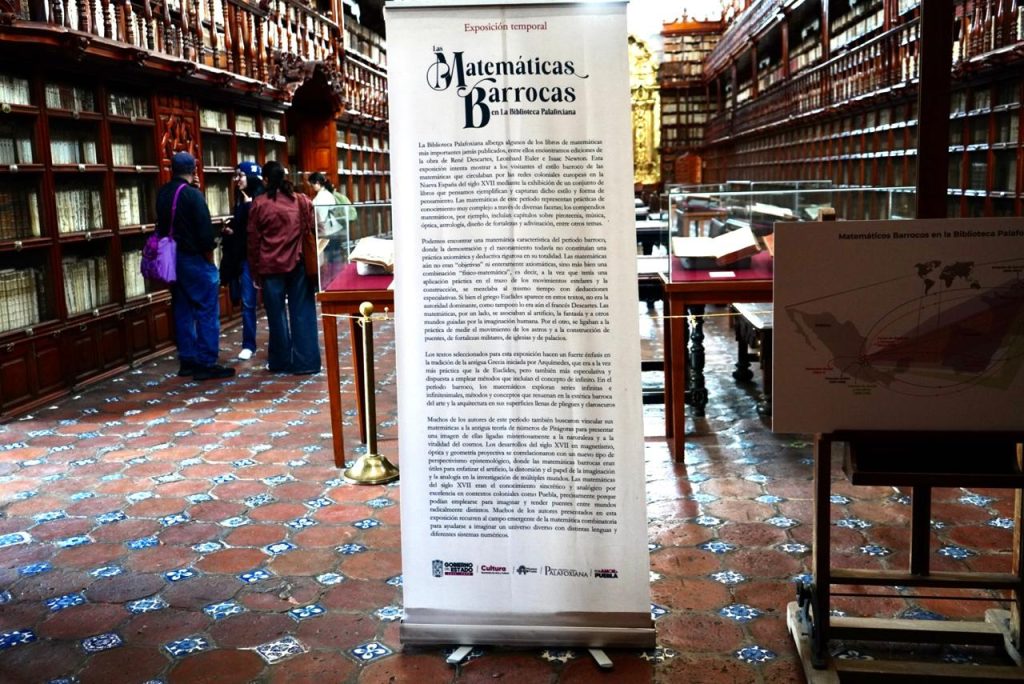
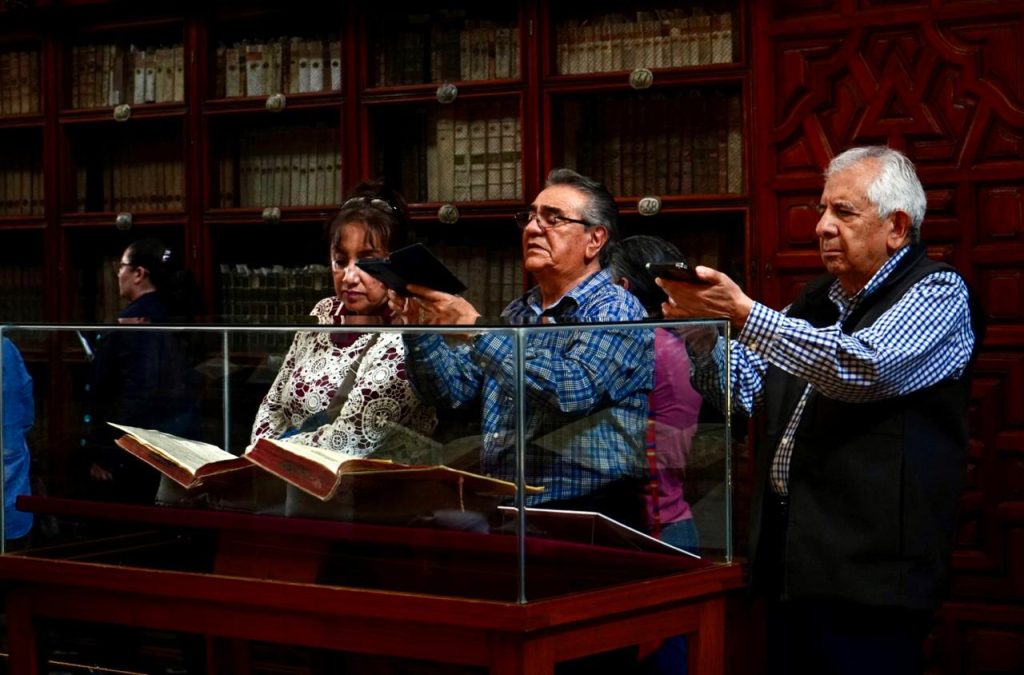
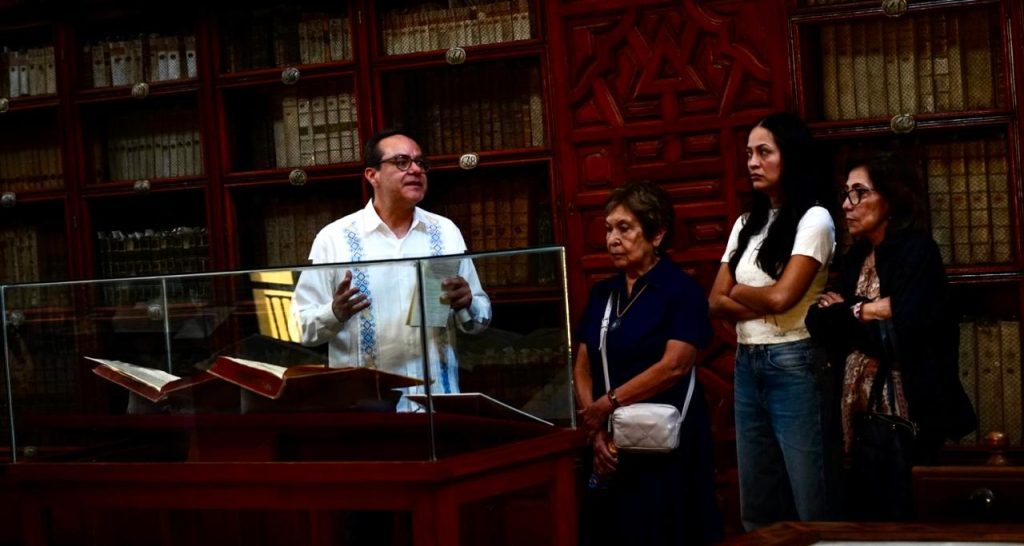
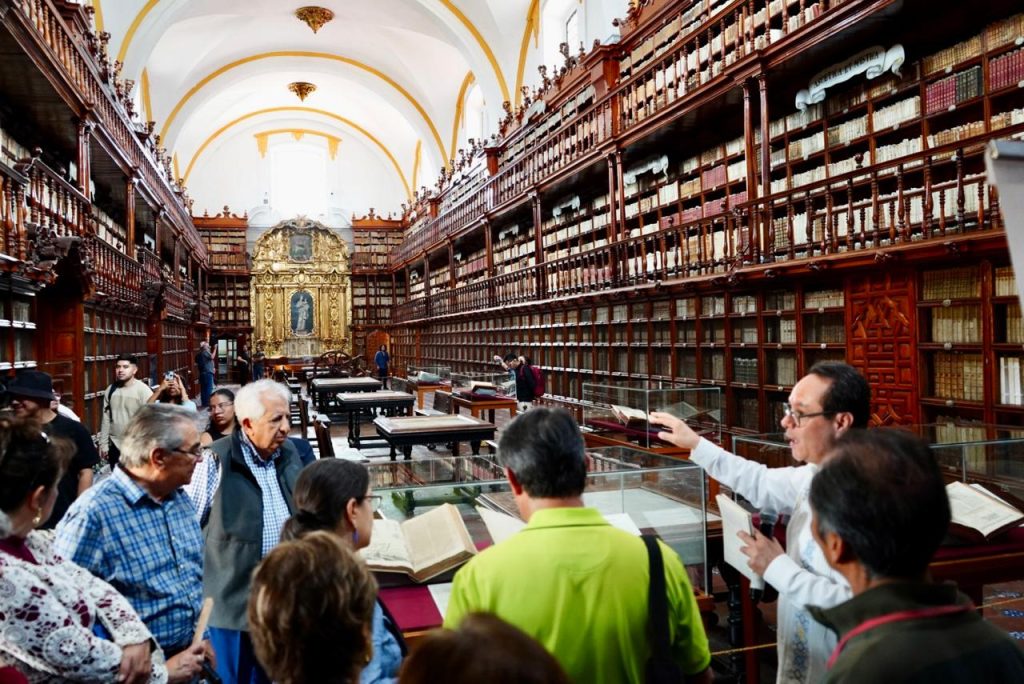
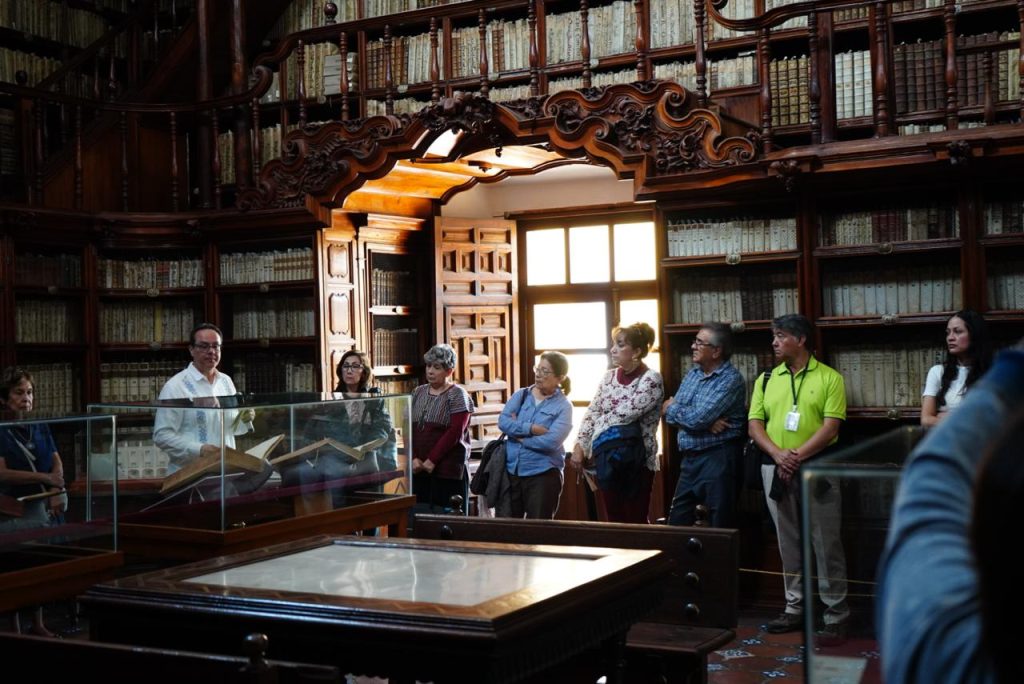
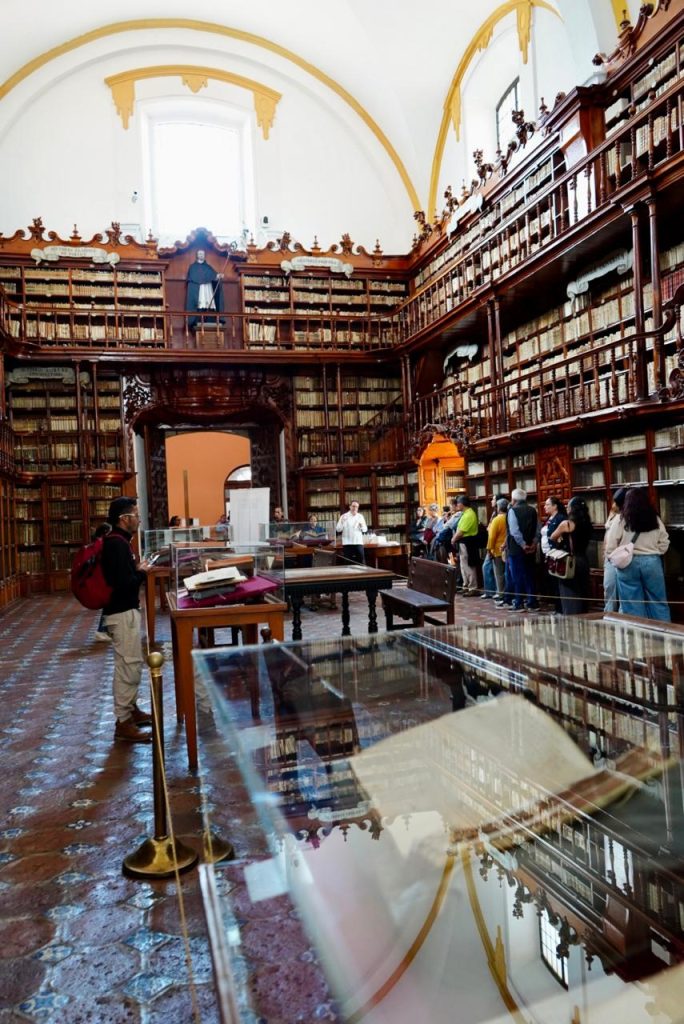
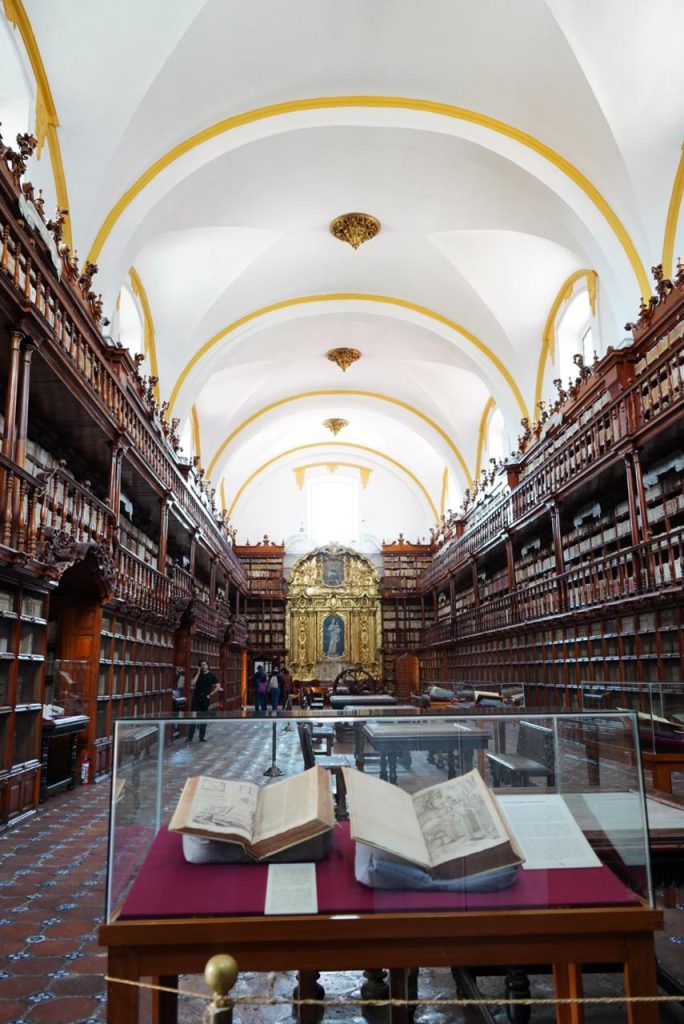
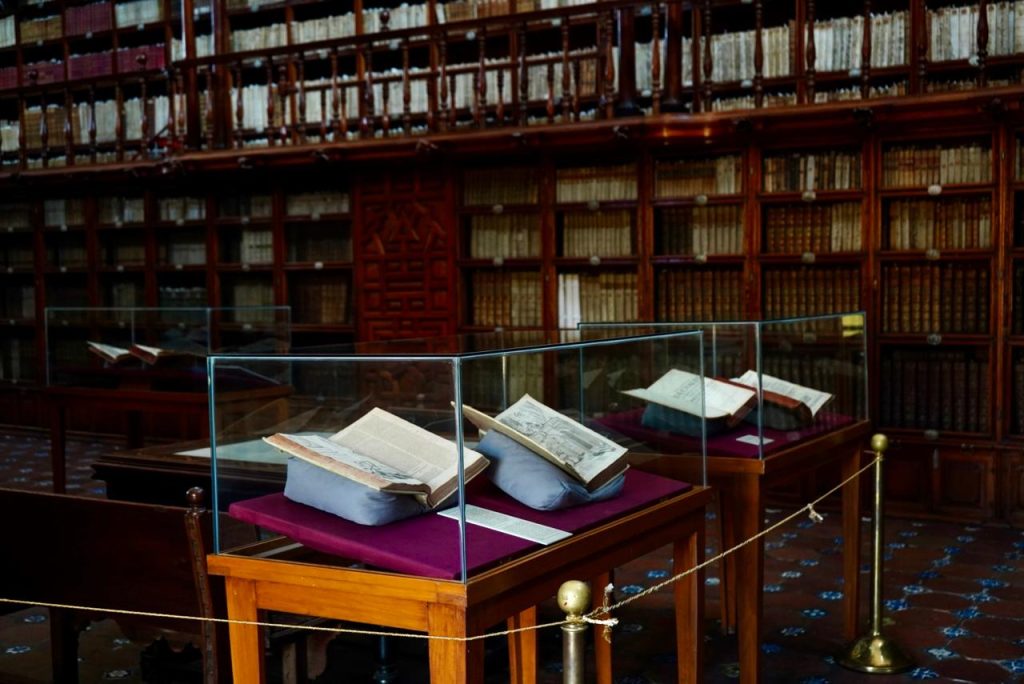
“Baroque Mathematics in the Palafoxiana Library”
Introduction: The Palafoxiana Library contains some of the most important mathematics books ever published, including first editions by René Descartes, Leonard Euler, and Isaac Newton. This exhibition focuses on a set of books that capture the Baroque style of mathematics that circulated across European colonial networks in 17th century New Spain. Mathematics was a very complex knowledge practice with many faces during this period; compendia included chapters on pyrotechnics, music, optics, astrology, fortress design, and divination, among other topics.
We find a distinctive mathematical practice in the Baroque period where proof and demonstration were not an entirely tight axiomatic deductive practice. Mathematics was not yet ‘objective’ nor entirely axiomatic, but rather a mixed “physico-mathematics” that was both practical and speculative. Although Euclid figures in these texts, he was not the dominant authority, nor yet was Descartes. Mathematics was associated with artifice and fantasy and the imagining of other worlds, as much as it was also a practical way of measuring the transits of the stars, and building bridges.
In the texts presented in this exhibition, there is a strong emphasis on the Archimedean tradition from ancient Greece, which was both more practical than Euclid but also more speculative and willing to engage with infinitary methods. In the Baroque period, mathematicians explore infinite series and infinitesimals, methods and concepts that resonate with the Baroque aesthetic in art and architecture with its dark folding surfaces.
Authors during this period also seek to connect their mathematics to ancient Pythagorean number theory, and present an image of mathematics mysteriously linked to nature and the vitality of the cosmos. Seventeenth century developments in magnetism, optics, and projective geometry correlate with a new kind of epistemic perspectivism. Baroque mathematics served this epistemological perspectivism in emphasizing artifice, distortion, the role of the imagination and analogy in investigating multiple worlds. Seventeenth century mathematics was the ultimate syncretic and analogical knowledge in colonial contexts like Puebla, precisely because it could be used to imagine and bridge radically different worlds. Many of the authors presented in this exhibition turn to the burgeoning field of combinatorics to help them imagine a diverse universe of different languages and different number systems.
Vitrina 1 The Compendia: Pluralistic and ‘Mixed’ Mathematics
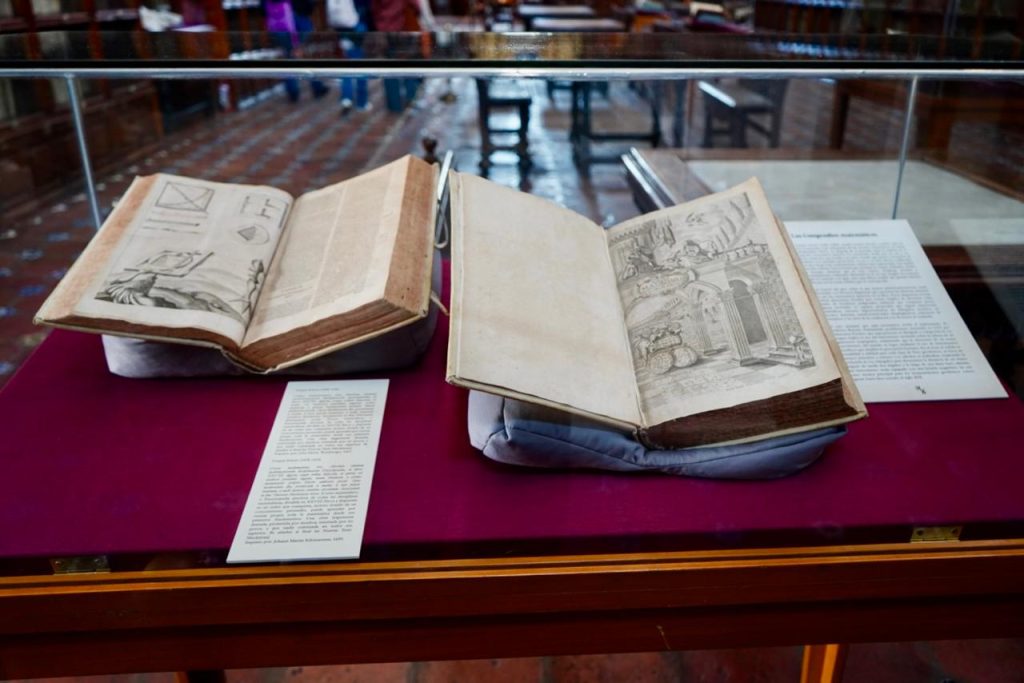
Gaspar Schott (1608-1666) was a German Jesuit scholar whose Cursus Mathematicus (1661) became an influential compendium of mathematical knowledge. The frontispiece captures the spirit of baroque mathematical practice. A chariot is entering a gate that opens onto a vast stadium which seems to enclose an infinite interior. The chariot is pulled by two animals, a bear and a lion, each encoded with the stars of their heavenly constellation; it rolls on two spherical wheels: the earthly sphere marked by oceans and continents and the heavenly sphere marked by stars. There are no humans riding the chariot, but an astrolabe instrument is mounted on top. The tiles on which the chariot rolls are engraved with various diagrams documenting the different ways in which mathematics appears in the book. These diagrams evoke planetary orbits traced by curves, angles of solar elevation, polygonal fortress design, balances comparingweights, figures inverted in mirrors, projectiles traversing parabolic flights, trigonometric ratios of triangles inscribed in circles, transformational symmetries unfolding, similarity relationships, and the art of quadrature and squaring.
The second book reveals the measurement device called the Pantometrum invented by Athanasius Kircher, perhaps as early as 1623, and presented here by his colleague and acolyte Schott. The image shows the instrument mounted on the head of a surveyor, emphasizing how knowledge of the world comes through enhancing human perception with scientific instruments. The instrument included a magnetic compass and was said to be versatile and useful for all geodetic purposes, whether measurement pertained to terrestrial or celestial bodies. Triangle geometry was used to determine the distance of an object, after measuring two angles along a baseline. The method remained the main technique for geodesic surveys well into the 19thcentury.
Vitrina 2 Baroque Optics: Between Mirrors and Light.
Claude François Milliet Dechales (1621-1678) was a French Jesuit, who wrote one of the most famous baroque mathematics encyclopedias in 1674, entitled Cursus seu mundus mathematicus, which was expanded with various additions in 1690, including a treatise on the history of mathematics. Dechales recounts how he isconcerned that the emergent algebraic methods hurt the imagination and turn people away from learning mathematics. He emphasizes the usefulness of mathematics, particularly logarithms and the methods of indivisibles, which allow one to study complex curves and distorted surfaces. His book presents a “mixed” mathematics implicated in the natural world, where geometry mixes with geography, number with music, and proportional curves with celestial motion.
The emphasis on distortion marks the work as a distinctly baroque aesthetic. Mirrors and other artifice are used to show how knowledge is mediated through optical and machinic technologies. Dechales shows how mathematics is linked to this new artificial and technological way of investigating nature. The book contains sections on Euclid’s Elements, pyrotechnics, geography, astronomy, architecture, navigation, optics, music, comets, fluxions, all explored using arithmetic, geometry, and combinatoric patterns. Drawing on the work of Cavalieri, Dechales writes that the indivisible method is “among the most beautiful inventions of the present century”. We also show a copy of the Cursus opened to an inscription by Méxicanpolymath Carlos de Sigüenza y Góngora (1645-1700) who purchased the 1690 edition in 1696 for 45 pesos. Below this inscription is another, indicating that the book was later sold in 1718 for 180 pesos.
Vitrina 3 Kircher’s Music: Of Animals and Exotic Sounds
Athanasius Kircher’s (1602-1680) Musurgia Universalis (1650) was a hugely popular compendium (1500 copies printed) in Colonial New Spain, Asia and Africa. Kircher was in correspondence with people across colonial networks, including scholars in Puebla, México, where many of his books were studied. Criollo scholars such as Carlos de Sigüenza y Góngora and Antonio de Alcalá y Mendiola, studied his books. This “universal music” book explored the science and geometry of acoustics, including descriptions of a wide array of phenomena – we find here diagrams of sound bouncing off polygonal shaped rooms, and diagrams of sloth musical refrains (the sloth was a south American animal never encountered by Kircher, who remained in Rome!). The book includes discussion of a combinatoric mechanistic machine “Arca Musica” that was said to generate all of music. The lower part of the book’s frontispiece shows Pythagoras (he stands on a 3-4-5 triangle) formulating his theory of music and number, as he points at blacksmiths hammering metal into form. Kircher offers a kind of Pythagorean philosophy of immanent vivacity, where number and harmony are inextricably bound together. His Arca mixes formal mathematical patterns with materiality and music across space and time, affirming a baroque fascination with the plurality of worlds. Kircher’s baroque mathematics draws attention to combinatoric machines and encounters with non-European cultures, empires, and ancient civilizations that contested European man’s claim to be the singular source of both knowledge and spiritual authority.
Vitrina 4 Combinatorics and Probabilism
Mathesis Biceps Vetus et Nova (1670), by Juan Caramuel de Lobkowitz (1606–1682), proposes the unification of mathematical knowledge from the past and the present. It seeks to explain everything that can be asked about order and measure. It includes topics in arithmetic, algebra, geometry, logarithms, combinatorics, trigonometry, mechanics, and astronomy. Although this work has been little studied by historians of mathematics, it contains the origins of probability theory and binary arithmetic. It includes the treatise Kybeia, in which Caramuel brings together moral theology and mathematics to answer questions about games of chance. In addition, through his recognition of the diversity and analogy among different numerical and linguistic systems, including indigenous American ones, Caramuel in the Meditatio Prooemialis proposes binary arithmetic as the simplest and most natural to human understanding, and as the first generator of all possible arithmetics. He does this many years before Leibniz, who is generally recognized as the first to formalize arithmetic for the binary numeral system.
Caramuel mastered more than twenty languages, including Guaraní, Araucano, and Nahuatl. He was a prolific writer and an active participant in the political and military issues of his time. His work covers theology, philosophy, science, law, linguistics, music, and architecture. He promoted the idea that mathematics and science were fundamental for understanding and defending the faith and the nation. He maintained active correspondence with Athanasius Kircher, with whom he shared an interest in languages and the search for a universal language. Shown here is Kircher’s Arca Steganographica, which used combinatorial methods to create and translate secret messages in multiple languages, such as Hebrew, Greek, Arabic, and Chinese.
Vitrina 5 Angle Trisection
Little is known about Antonio de Alcalá y Mendiola, who was born in Puebla de los Ángeles in 1658. He left three manuscripts, which are in the Biblioteca Palafoxiana. These include familiar topics such as geometry, geography, astronomy, algebra, perspective, catapulting and astrology, as well as topics specific to New Spain, such as a dictionary of Nahuatl language as well as geographical and astronomical data specific to New Spain. His manuscripts contain many pages of diagrams, some copied from other treatises and other created for his own mathematical explorations.
Alcalá was obsessed with the Ancient Greek problem of trisecting the angle, which had long been known to be impossible to do with Euclidean compass and straightedge constructions (though this was only proven in 1827). His connection to scientific circles in the Spanish Empire is evident in his mentioning of José Zaragoza as well as Juan Caramuel y Lobkowicz. In his Mathesis Biceps of 1790, Caramuel (born in Madrid in 1606) writes that he has discovered a new method to trisect the angle (through approximation) which is shown in the vitrina (p. 330). Alcalá uses the same letters as in Caramuel’s text (F, G, B, H and I), exploring different configurations. Is he trying to decipher Caramuel’s construction (whose accompanying diagram uses different letters!) or trying to discover a method of his own?
Vitrina 6 Squaring the Circle
Gregoire de San-Vicente was a Flemish Jesuit (1584-1667) who is best known for his work on the quadrature of the hyperbola and for showing how areas under the rectangular hyperbola encode logarithmic relationships, anticipating the concept of the natural logarithm as an area function. He also gave one of the clearest early accounts of geometric series and used them to resolve versions of Zeno’s paradox. San Vicente was a student of Christopher Clavius, who has a significant presence at the Biblioteca Palafoxiana. He was well known by much more famous mathematicians such as Leibniz and Huygens, and exchanged letters with Athanasius Kircher, but his major work, Opus geometricum, contained an error that resulted in its more general discreditation.
The vitrina contains Tome 1 and Tome 2 of San-Vicente’s book Opus geometricus, which was printed in 1647, the year after the founding of the Palafoxiana. The frontispiece of tome 1 is a baroque triumphant allegory illustrating San Vicent pretension of having squared the circle, an Ancient Greek geometry problem that was widely known to be unsolvable using compass and straightedge construction. The frontispiece features geometry and faith, symbolising the author’s ambition of linking mathematics to theology, and underlining the circle as a divine shape. On p. 1210, San-Vicente uses the Archimedean “method of exhaustion” and the contemporary ideas of the indivisible to square the circle, thereby stretching the limits of Euclidean geometry.
Vitrina 7 Instruments of Gnomonics and Geography
Antonio de Alcalá y Mendiola (1658-1741) was born in Puebla de los Ángeles. He served as a priest in that diocese, as well as accountant for the convents of nuns in Puebla. For thirty-five years, he published annual Prayer Booklets for the use of secular clergy as well as Almanacs “adapted to that hemisphere.” He left three manuscripts, which are in the Biblioteca Palafoxiana. These include familiar topics such as geometry, geography, astronomy, algebra, perspective, catapulting and astrology, as well as topics specific to New Spain, such as a dictionary of Nahuatl language as well as geographical and astronomical data specific to New Spain. For example, the table on p. 44 shows the oblique ascension of the sun data for the latitude of Puebla, which is 19,10. This precise and time-consuming data collection shows not only the spread and creation of scientific knowledge to New Spain, but the importance of local data in the emerging global enterprise of science.
The manuscript also contains an instrument created by Alcalá, which enables the user to calculate the time at night (when the sun’s position is not visible) by pointing its centre to the north star, turning the rotating paper dial to the correct day of the month, and pointing a gnomon to the big dipper. Unfortunately, Alcalá’s gnomon has been lost. This “nocturnal” is an example of a broader class of interactive devices called volvelles. The first European one was created by the Majorcan Ramon Llull, in his 1306 Ars Magna, who learned about them from Arabic astronomers.
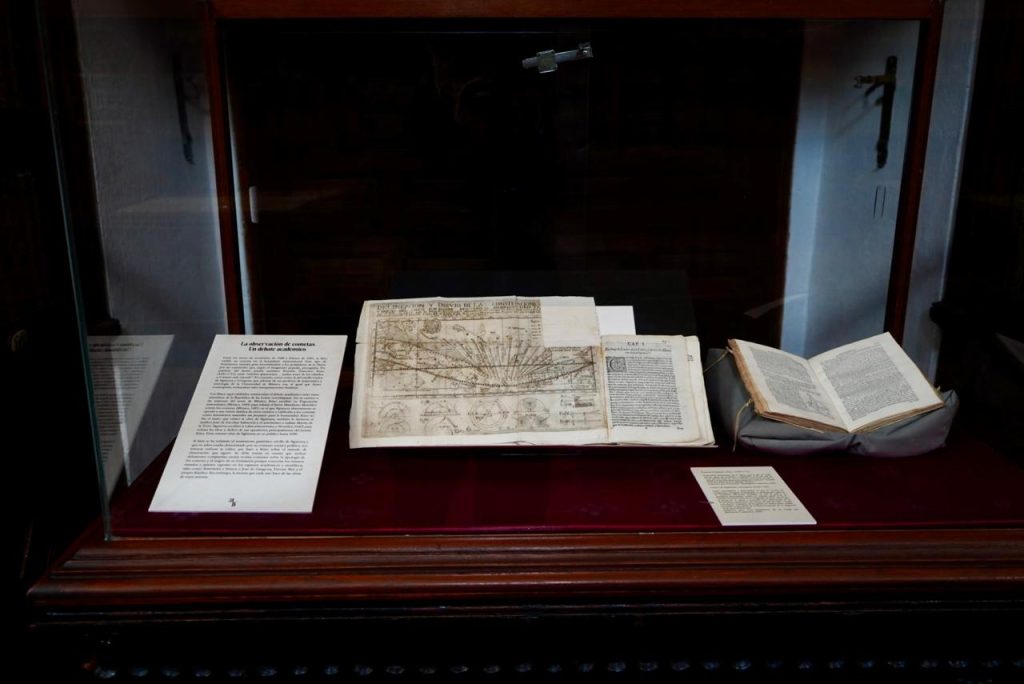
Vitrina 8 The Observation of Comets: An Academic Debate
Between November 1680 and February 1681, a comet became visible in the northern hemisphere, a phenomenon that caused great uncertainty among the people of the Earth because of the catastrophes it was popularly believed to foretell. In the words of the distinguished Austrian Jesuit Eusebio Francisco Kino (1645–1711), these “celestial apparitions… usually make even the most manly spirit tremble.” By contrast, voices such as that of the creole Carlos de Sigüenza y Góngora, who, besides being a professor of mathematics and astrology at the University of Mexico, was, like Kino, a cosmographer, rejected such fatalistic interpretations.
These books testify to the scholarly debate between these members of the New Spain Republic of Letters. Kino, on his way to the northern missions, wrote his Exposición astronómica (Mexico, 1681) to rebut the brief Manifiesto filosófico contra los cometas (Mexico, 1681), in which Sigüenza openly expressed his opposition to those ideas and instead described comets as natural phenomena that posed no harm to humanity. Kino was not the only one who criticized Sigüenza’s little work; the physician José de Escobar Salmerón and the astronomer and military man Martín de la Torre also did so. Sigüenza then wrote the Libra astronómica y filosófica (1682), which was not published until 1690, a much longer work, to refute the ideas and statements of his opponents, mainly Jesuit Kino.
Although Sigüenza’s creole patriotic feeling has been noted, and although his knowledge was shaped by his social and political context, we are interested in focusing on his criticism of Kino’s observational method. It should be taken into account that both debaters shared certain common theories about the typology of comets and the origin of their formation because they knew the same treatises and authors current in academic and scientific circles, such as Aristotle and Seneca, or José de Zaragoza, Vicente Mut, and Kircher himself. However, the way each of them read these sources was very different. As a mathematician, Sigüenza criticized Kino for the looseness of his calculations in determining the comet’s position with precision and for not having made successive observations and compared them with those of other observers in other geographic locations.

